Alarm.com Posts

Posted By

Qolsys has released Firmware Version 4.2.0 for the IQ Panel 4, and the IQ4 Hub (coming very soon). This is a huge update with lots of new features and bug fixes. In this blog, we'll discuss what to expect from this release. The IQ Panel 4 MUST be on version 4.1.1 to install version 4.2.0.

For those of you with panels that can't access WIFI, we've updated our Qolsys IQ Panel 4 Firmware Updates page with the newest release. In addition, if your panel isn't yet on version 4.1.1, we have that file available too, so you can get your panel completely updated just by visiting our page. Just scroll down the page until you see the green download button for 4.1.1. Instructions on updating are included on the page.

The marquee feature in this release is support for the new Qolsys IQ WIFI 6. This is an all-new, IPv4 and IPv6 capable router purpose-built for security professionals. Out of the box it has three (3) partitions enabled. A Guest partition that is capable of using both 2.4 GHz and 5 GHz, and the Main partition that also supports both 2.4 GHz and 5 GHz. The biggest differentiator for the IQ WIFI 6 is that it also has a Security partition. This partition is there to support all of the security system elements that use WIFI. This includes the panel itself, any Alarm.com video devices, and remote keypads that use WIFI in order to communicate with the panel. By putting security devices together on a partition that is controlled by the alarm dealer, WIFI issues for accidental configuration changes made by the end-user are virtually eliminated.

Alarm.com cameras will automatically move themselves to the Security partition if they are initially added to the network on one of the other partitions. The alarm dealer will have access through the Partner Portal and through Mobile Tech to configure and troubleshoot the IQ WIFI 6. The end-user will have access to configuration settings through the end-user website and the Alarm.com app.

The IQ WIFI 6 offers band steering, which causes WIFI devices to switch between the 2.4 GHz and 5GHz bands. This is an ongoing process that optimizes both speed and reliability for each device on the network. Let's say you're walking through your home, on your smartphone, which is connected to WIFI, and you're surfing the web as you walk. When you're close to the router, 5GHz is likely the best band for you to be using. But as you walk further from the router, 2.4 GHz may become the better option. The IQ WIFI 6 will automatically cause you to switch from 5GHz to 2.4 GHz without you ever even knowing a change took place. Band steering is always enabled on the IQ WIFI 6. That means if you change the SSID for the 2.4 GHz band, the SSID for the 5 GHz band will be changed to match it.

The Qolsys IQ Panel 4 has an open slot where a new daughterboard can be installed. Qolsys will soon be offering a Zigbee card (QC000E-840) that can be installed in this slot. With the Zigbee card installed, the IQ Panel 4 can support both Zigbee automation devices and Zigbee security devices. There are alarm dealers out there (Comcast Xfinity) who use Zigbee sensors for their proprietary systems. If you have one of these systems and thought you were stuck either staying with your current company or purchasing all new equipment, rest easy. By adding the Zigbee card to an IQ Panel 4, you can replace just the alarm panel, keep your existing sensors, and move to any dealer who supports Alarm.com communication. It just so happens, Alarm Grid is one of those dealers! Firmware version 4.2.0 adds end-to-end Alarm.com support for Zigbee automation devices when the optional Zigbee daughtercard is installed.

This firmware release also prepares the IQ Panel 4 and IQ4 Hub to support Z-Wave 800 Series. At the core of Z-Wave 800 Series are the ZG23 SoC (System on Chip) and the ZGM230S, a module with a ZG23 already connected. Devices using this hardware will have low sleep and active current consumption, with 50% longer battery life than Z-Wave 700 Series. For modules that use coin cell batteries, Z-Wave 800 supports up to ten (10) year battery life. Using the ARM Cortex-M33 microprocessor, Z-Wave 800 delivers ~20% more processing power than the previous Cortex-M4. It can also support Z-Wave Long Range (LR), which has a wireless range of ~1.5 miles.

There is so much to unpack in 4.2.0 that we can't cover it all here. PowerG PIR Cameras, like the PG9934 will now send up to six (6) images to the Alarm.com backend for each device trip during the same arming period. Previously, only images from the first alarm trip were sent. There is a fix for improved WIFI connectivity between IQ Remote Keypads and the alarm panel, basically causing WIFI to toggle OFF and then ON if the remote keypad loses connection to the panel. There is new PowerG Modem Firmware (Version 3.0 / Build 10.87). To see everything that is included in this firmware release, you'll need to read the full Release Notes.

What do you think about Firmware Version 4.2.0 for Qolsys IQ Panel 4 and IQ4 Hub? Are you looking forward to the release of the new panel? Have you been following Z-Wave 800, or is this the first you've heard of it? Drop a comment below and let us know what you think, we always look forward to hearing from our readers. Until next time, stay safe!

Tags: , , , , , , , , , , , , , , , ,

Comments


Posted By

The Smart Arming feature can be enabled for any residential customer who has an interactive monitoring plan with Alarm.com. Once enabled, the feature can easily be configured using either the customer website or iOS or Android app.

Once configured, the Smart Arming feature will automatically arm the system to the Stay Mode once the occupants of the home have gone to bed. This can be accomplished using a schedule, or by configuring certain door and/or motion sensors to work in conjunction with the feature. You can reach the Smart Arming settings by going to Security, or through the Automation page. The Smart Arming programming is listed as Goodnight for Arming, and Wake Up for Disarming.


For example, you can set the system to Arm Stay at 10:00 PM, or you can set the system to Arm Stay when no activity has been detected for 30 Minutes between 10:00 PM and 11:30 PM (this is just an example, and you can use whatever time frame you want). If you choose the latter option, you then configure which zones you want to apply this logic to.

For the Stay Arming feature, doors, windows, and motions can be used along with the feature. So, once you choose the zones to be used with this logic, if no activity has been detected on ALL of those zones for a full 30 Minutes, and the time is between 10:00 PM and 11:30 PM, the system will automatically Arm Stay. Smart Arming logic is canceled if the system is already Armed Away.

For Disarming the options are similar. You can set the system to Disarm at a specific time, or you can set it to Disarm when motion is detected on certain motion detectors within a specific time window. For example, in our screenshot below, you can see we have our system set to Disarm if the Upstairs Motion detects movement between 8:00 AM and 9:00 AM. We also have it set so that if no motion is detected, the system will still disarm at 9:00 AM, which is sort of the best of both worlds.

Notice that only Motion Detectors are now available to tie to the Disarm logic. You don't want someone opening a door to disarm the system. By the same token, be sure that no outdoor motions are configured to work with this automation.


This is an excellent new feature that can go a long way toward preventing false alarms. No more forgetting to disarm the system when you go to let the dog out in the morning. As long as you set it up so that a motion you walk past on your way to the door causes the system to Disarm, you're all set. No more laying in bed wondering if you remembered to set the alarm. Now, as long as you have configured the Goodnight options, you know your system will arm itself based on either a schedule or activity (or lack thereof) combined with a time window.

The following Alarm.com compatible panels support this feature:

Panel Compatible Motion Sensor
Groups (Arm & Disarm)
Compatible Contact
Sensor Groups (Arm Only)
2GIG GC2/e 4, 10, 23 1, 2, 3, 4, 5, 8, 10, 23
2GIG GC3/e 4, 10, 23 1, 2, 3, 4, 5, 8, 10, 23
2GIG Edge 4, 10, 23 All
DSC PowerSeries Neo/Pro 4, 5, 9, 10 4, 5, 9, 10
Interlogix Concord 15, 17, 18, 20 14, 16
Interlogix Simon XT/XTi/XTi-5i 15, 35 14, 16
Qolsys IQ Panel 2 17, 20, 44, 43, 35 8, 9, 10, 12, 13, 14, 16, 25
Qolsys IQ Panel 4 17, 20, 44, 43, 35 8, 9, 10, 12, 13, 14, 16, 25
Note: Sensor-based disarming is only available in the Simon XT/XTi/XTi-5i with firmware versions below 193a.

What do you think of this new Alarm.com feature? For that matter, what do you think of Alarm.com's commitment to bringing you new products and features in general? They're doing an excellent job of listening to customers and responding with great new options. Drop us a note in the comments and let us know what you think. We always look forward to hearing from you!

Tags: , , , , , , , , , , , , , , , , , , , , , , , , , , , , , , , , , , ,

Comments


Posted By

Alarm.com is offering a new feature called Perimeter Guard™ proactive defense for their compatible cameras. All that is required to use this feature is a video plan that includes video analytics, a compatible camera, and a video analytics recording rule applied to an appropriate camera.

This new feature is considered a proactive method of defense because when an analytics rule is activated on a compatible camera with the Perimeter Guard™ feature enabled, it causes the camera LED to flash, and a sound to be emitted from the camera's speaker, when supported. This is done to let the potential intruder know that they've been seen and to encourage them to move along to some other location.

The following cameras support the Perimeter Guard™ feature:

Camera Model Firmware Required Behavior Supported
ADC-V724/724X Version 0.6.1.387+ LED and Audio Alert
ADC-V523/523X Version 0.6.1.387+ LED and Audio Alert
ADC-V723/723X Version 0.6.1.387+ LED Only
ADC-VC727P All Versions LED and Audio Alert
ADC-VC827P All Versions LED Only
ADC-VC847PF All Versions LED Only
ADC-VC728PF All Versions LED Alert
ADC-VC728PF Version 0.6.3.601+ LED and Audio Alert
ADC-VC838PF All Versions LED Only
ADC-VDB770 Version 02199+ LED and Audio Alert

The Alarm.com Video Analytics feature must be enabled in order to use this feature. This allows the user to be as sure as possible that it is actually an intruder that is causing the disturbance, rather than a neighbor's pet running loose or some other source of a potential accidental activation. A compatible Alarm.com camera that has been properly calibrated for use with the analytics feature ensures that false activations are virtually eliminated. Once the camera has been calibrated simply create a Video Analytics Rule for the calibrated camera and choose to Activate Perimeter Guard.

In the "Activate Perimeter Guard" section of the recording rule, choose the option or options you want to enable. You can choose to set up a trip wire recording, or a ground zone recording. Refer to the full instructions on setting up video analytics rules that we've linked above for more information on these two (2) different options.

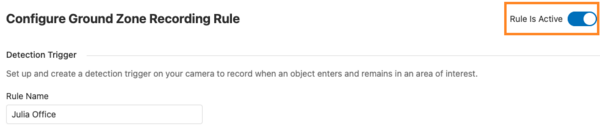
Basically, a trip wire recording allows you to draw a virtual line within the camera's field of view, and if anyone crosses that line while the rule is active, a clip recording is triggered, and the options selected for the Perimeter Guard feature are also triggered. When using a ground zone, the behavior is similar, but instead of an invisible trip wire, you're configuring an invisible space within the camera's viewing area. If someone enters that space and stays for a specified amount of time, a recording and the Perimeter Guard behavior are activated.

Depending on the camera you are using, you have the option to illuminate the LED, and for how long, to have the camera produce sounds, if supported, and to set a delay between alerts. The LED duration options are 3, 5, 10, or 30 seconds. The "Delay between Alerts" options are 30 seconds, 1, 2, 3, 4, 5, 10, or 15 minutes. The Audio Alert options are shown in the screenshot below. This feature can be configured using either the customer website or the Alarm.com app.


Once you've selected the options you want for the rule, be sure to Save and then be sure that the "Rule is Active" toggle is enabled at the very top of the rule creation screen. If you ever need to disable this rule, you can easily do so by toggling the rule off, rather than deleting it. Then, when you're ready to use it again, simply toggle it back on.

This is another example of how Alarm.com continues to innovate within the video surveillance space. Particularly when outdoor cameras are used, this feature can go a long way toward not just notifying of a break-in, but discouraging one. For Alarm Grid customers, you will need either our Platinum Plan (Full or Self) or a Stand-alone Video Plan.

If you're activating new video service with us, and you want to check out this feature, be sure to tell your activator that you want to enable Video Analytics. If you're already a video customer and you would like to have the Video Analytics feature enabled for your account so that you can check out this intriguing new feature, drop an email to support@alarmgrid.com and let us know, we'll gladly enable it for you. We pay more for the Video Analytics feature, but we don't charge more for it. This is why we don't simply enable Video Analytics for every video account automatically.

Tags: , , , , , , , , , , , , , , , ,

Comments


Posted By

2GIG strongly recommends that all Edge panels be updated to the latest firmware version, 3.1.1.016. This firmware has a number of new features and bug fixes. New features include Z-Wave siren support and updated remote keypad features. For a full list of updates, read the release notes.


The 2GIG Edge supports a WIFI connection in addition to the AT&T or Verizon cellular communicator that comes built-in. For any Alarm.com panel that is connected to WIFI, OTA (Over the Air) firmware updates that are downloaded to the panel using WIFI are free. However, for those panels that don't have access to WIFI, a firmware update that is sent to the panel via cellular data usually incurs a small fee. Alarm Grid passes this fee on to our customers with no markup, when it is assessed.

But, for a limited time, Alarm.com is offering to update the 2GIG Edge panel automatically with no fees assessed, even when the firmware has to be downloaded via cellular data. That's how important 2GIG and Alarm.com feel this update is. Beginning on Monday, September 12, 2022, Alarm.com will push the latest firmware to all monitored 2GIG Edge panels.

These automatic updates will take place only during daylight hours, and only when the alarm panel is disarmed. When the firmware update is complete, the alarm panel will reboot. This is a normal part of the update process. Additionally, if there are any remote keypads associated with the panel, they will also be updated once the main panel has completed its update. Alarm.com expects the process of updating all 2GIG Edge panels to be completed by the end of October 2022.

If you'd like to go ahead and update your panel immediately, you can access the necessary files for the update on our 2GIG Edge Firmware Update Page. Instructions for updating the 2GIG Edge can be found in this helpful FAQ. Otherwise, do nothing and your panel will be automatically updated OTA by Alarm.com at no charge, in the near future.

Tags: , , , , , , , , , , , , , , , , , , , , , , , ,

Comments


Posted By

Alarm panel manufacturers routinely offer panel firmware updates. This allows them to add features and correct issues. However, most DIY users don't have access to the restricted portion of the company's site where these files are housed. Alarm Grid offers the latest firmware file downloads.

Most alarm panels can be updated Over-the-Air (OTA) using either Alarm.com or AlarmNet360. AlarmNet never charges anything for these updates, and Alarm.com also offers them for free, unless they have to be sent to the panel using cellular data. In that case, the update will incur a small fee, depending on the size and number of updates that need to be sent.

Qolsys panels will not perform an OTA update unless the panel is connected to WIFI. If you have one of these panels installed in a location where WIFI is not available, then the only option is to either update using a cell phone as a WIFI Hotspot, or download the firmware files, and then install them via either Micro SD Card (IQ2/IQ2+) or Access Point (IQ4).

Honeywell L5200, L5210, and L7000
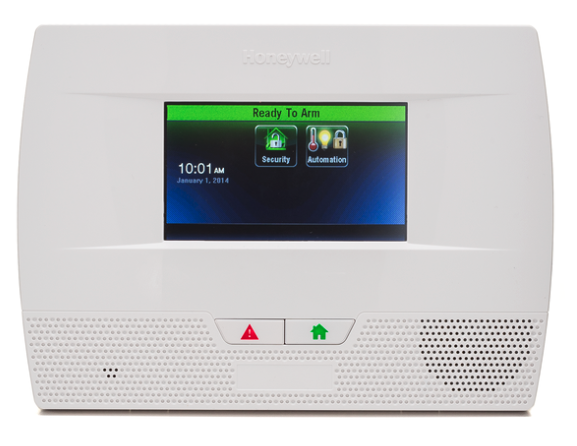
Honeywell used to offer free firmware updates for the LynxTouch panels that they pushed remotely using AlarmNet360. It was a messy process, AlarmNet tech support was required to request these updates individually, per account. So, sometime after the introduction of the Lyric panel, they stopped this practice. The Lyric can only be firmware updated using AlarmNet360, but the update can be requested by the dealer, and now, the customer can also request the firmware update via the panel. When Honeywell, now Resideo, ceased offering OTA updates for the LynxTouch panels, they released the Honeywell LYNXTOUCH-MSD Firmware Update Tool. This tool can be used to update the L5200, L5210, or L7000 panels.

When an L5200 is updated to the latest version, it becomes an L5210 internally, though there are certain physical traits of the L5200 that won't change, like the screen size. Depending on when you purchased the LYNXTOUCH-MSD tool, it may come with the latest firmware version already on the SD Card (it comes with both L5210 and L7000 firmware already loaded). However, if you purchased your update tool when they were first released, it will have an older firmware version on it, and you will need to download the newest firmware to the SD Card and update the panel again to get the most current version. The update files are housed on the Resideo website in the password-protected portion of MyWebTech, so we offer the files for download from our site:

2GIG Go!Control 2 (GC2) or 2GIG GC2e
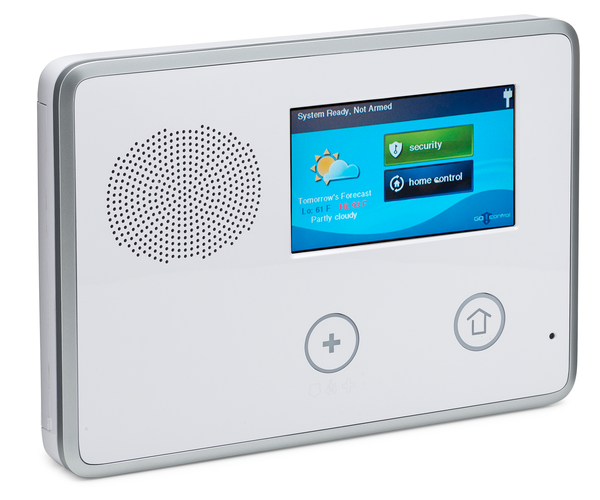
The 2GIG GC2 and 2GIG GC2e have a couple of different methods for updating the firmware. There is the 2GIG UPDV Easy Updater Tool and the 2GIG UPCBL2 Firmware Update Cable. The updater tool is geared more toward a professional installer who will be updating multiple different panels over the course of years. It comes with a version of either the 2GIG GC2 or GC2e firmware loaded but the tool itself will then have to be updated when newer firmware is released. The files to load are available from our site and are linked below.

The updater cable is the method of update most DIY users choose to use. It requires that the user have a windows computer available. The cable is a fixed length, so the computer that will be used needs to be near the alarm panel in order to perform the update. Ideally, a laptop is used. Instructions for using the updater cable to load the latest firmware onto a 2GIG GC2 or 2GIG GC2e can be found here. Instructions for loading new firmware onto the 2GIG UPDV Easy Updater Tool can be found here. Instructions for using the updater tool to update a 2GIG GC2 or GC2e panel once it has the latest file loaded can be found here.

The 2GIG GC2 and 2GIG GC2e firmware pages are linked below. Each page has both Updater Tool and Updater Cable files:

2GIG GC3 and 2GIG GC3e
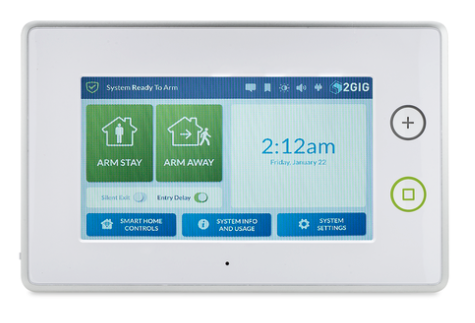
The 2GIG GC3 and 2GIG GC3e technically use the same firmware. The 2GIG GC3e was released at firmware version 3.2.1, so any GC3e panel will have at least this version of firmware already installed. Alarm Grid offers firmware versions 3.0.1 up through 3.2.4.6725 on our 2GIG GC3 Firmware Update Page. On our 2GIG GC3e Firmware Update Page, we offer 3.2.3.6713 up through the current version which, at the time of this writing, is 3.2.6.6770.

The 2GIG GC3 and 2GIG GC3e are both much easier to update than the 2GIG GC2 or GC2e. Both 2GIG GC3 versions offer WIFI, which makes OTA updates simple, as well as free. For systems that need it, an OTA update can be pushed from Alarm.com via cellular for a nominal fee. Again, Alarm Grid offers this type of upgrade to our customers at our cost, with no markup. If WIFI is not available at the panel, and a user doesn't want to pay for an OTA update, we offer the upgrade files from our site. This FAQ provides a walkthrough on how to perform the update using the files from our site. Instructions for performing the update are also listed on the page along with the firmware files.

2GIG Edge
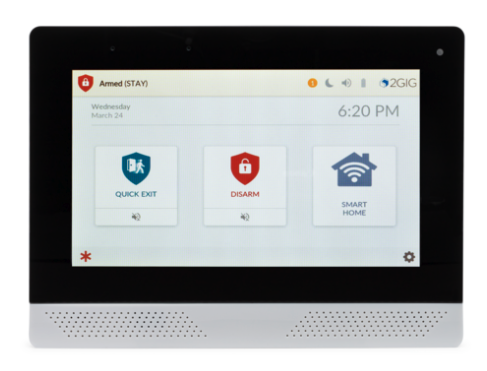
The 2GIG Edge updates in the same way as the 2GIG GC3 and GC3e. It has a USB port located on the top of the panel. Once the firmware update file has been loaded onto the root directory of a USB drive, the drive is inserted into the port on the panel's top and the panel prompts the user to update. For full instructions on updating a 2GIG Edge, check out this FAQ.

Qolsys IQ Panel 2 and IQ Panel 2 Plus
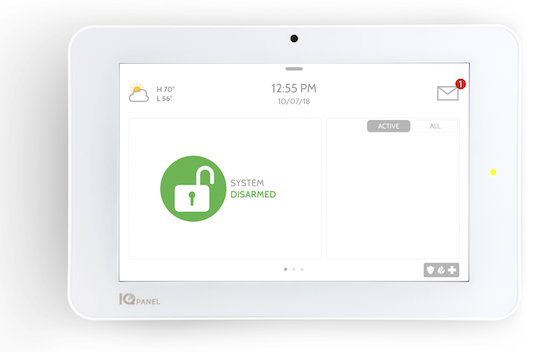
The IQ Panel 2 and IQ Panel 2 Plus also use the same firmware version. The difference between the two panels is hardware. The IQ Panel 2 does not support PowerG, and the IQ Panel 2 Plus does. As noted above, Qolsys panels will not download firmware updates via cellular data, so the options are to connect the panel to WIFI, temporarily connect the panel to a Hotspot on a cellular phone, or update locally using a Micro SD Card. The step-by-step instructions for loading the firmware from an SD Card are shown on the firmware update page.

Qolsys IQ Panel 4
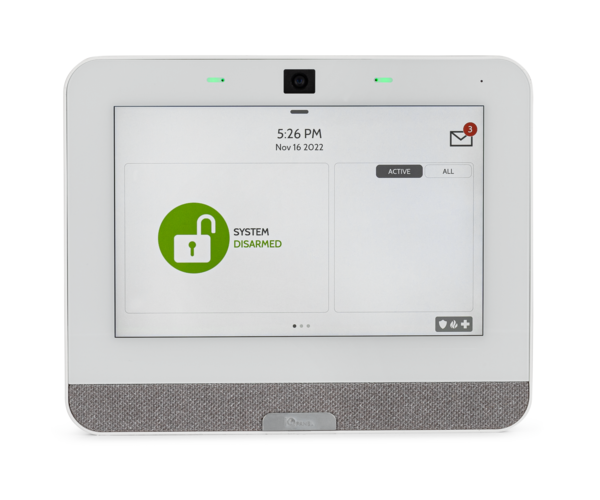
The Qolsys IQ Panel 4, like the previous IQ Panels, will not download firmware updates via cellular data. However, unlike the IQ Panel 2 or IQ Panel 2 Plus, the IQ Panel 4 does not have a Micro SD Card slot. Instead, if WIFI is not accessible by the panel, either directly or via a cell phone Hotspot, then the firmware update files have to be downloaded to a phone or tablet, then the phone or tablet must be connected to the IQ Panel 4 Access Point, and the files then loaded to the panel from the phone or tablet. Instructions for updating using the Access Point are available on the firmware download page.

Above are links to all the different panel firmware pages we offer here on the Alarm Grid site. In addition to alarm panel firmware, we also offer some firmware pages for the Honeywell Home TUXEDOW or Resideo TUXEDOWC touchscreen keypads as well as the older Tuxedo Touch firmware. We don't have a page for the older 6280 touchscreen keypads, but if you need access to that firmware, send an email to support@alarmgrid.com letting us know what you need and we can get you access to it.

As mentioned above, the Lyric panel can only be updated via AlarmNet360 and in order to update the firmware, the panel has to be actively monitored. The same is true of the newer Honeywell Home and Resideo ProSeries panels (PROA7, PROA7PLUS, PROA7C, and PROA7PLUSC). These panels must be actively monitored and registered with AlarmNet360 before an update can be applied to them.


Tags: , , , , , , , , , , , , , , , , , , , , , , , , , , , ,

Comments


Posted By

Johnson Controls released a Technical Advisory Bulletin on Monday noting that some PowerSeries Neo, Pro LTE, and Internet Dual-Path Communicators have labeling errors. The serial number on the box appears to be incorrect. Comms built between August 15, 2021, and July 29, 2022, are affected.

The model numbers affected are the DSC TL880LECVZ, TL880LECAT, TL880LEBAT, TL880LEBTL, and TL880LECTL. This is a labeling error only and does not affect the signal transmitting, or Alarm.com remote control capabilities of these communicators in any way. The mixup seems to be with the name on the label on the product, and the serial number on the label on the box.

The model name listed on the label of the product is incorrect, while the serial number listed on this label is accurate. The model name listed on the sticker for the box is correct, but the serial number listed on the box is incorrect. So, be sure when registering one of these units that you use the serial number from the sticker for the product and not the one from the box.

The following products, built during the listed date range, are affected:

Model Name Production Dates
TL880LECVZ January 4, 2022 - July 29, 2022
TL880LECAT July 5, 2022 - July 29, 2022
TL880LEBAT November 15, 2021 - July 29, 2022
TL880LEBTL November 15, 2021 - July 29, 2022
TL880LECTL June 6, 2022 - July 29, 2022

Beginning July 29, 2022, new, updated and correct labels should be placed on these products. Remember, the performance of communicators that were manufactured during this timeframe is not compromised. This is only a labeling error, so as long as the serial number taken from the sticker affixed to the product itself, or the IMEI number from the printed circuit board is used everything should work as intended. DSC offers a handy Date Code Lookup tool at this site. You can find information on looking up a date code for any DSC product on that page.

The fact that this issue wasn't discovered sooner seems to indicate that this is a very minor issue. What do you think about this announcement? Do you often use these communicators? Have you run across this issue? Leave us a comment below and tell us what you think. We always enjoy hearing from our readers. That's all for today, until we meet again, stay safe!

Tags: , , , , , , , , , , , , , , ,

Comments


Posted By

Power over Ethernet, also known as PoE allows power to be sent to a device using the same ethernet wire and RJ45 connector that is used for the network connection. Originally designed with VoIP phones in mind, PoE has quickly become a desirable option for IP cameras and other networked equipment.

Before we talk about PoE, we should discuss network cabling. Category 5 (Cat5), Category 5e (Cat5e), and Category 6 (Cat6) cables all consist of four (4) twisted pairs of wire, or a total of eight (8) conductors. The differences between these various categories of cable have to do with their ability to transfer data, over what distance, and at what speed. Generally, Cat6 is faster than Cat5 or Cat5e, and is less prone to crosstalk or noise issues.

The main point we want to make about network cabling, though, is this: With eight (8) conductors, any device that connects to a network using one of these cables, without using PoE, is wasting a number of wires. In fact, there are now cheaper cables out there that only have four (4) conductors, rather than the full eight (8). So, that brings us to two points. It makes sense that PoE has come into existence, and if you're preparing to use PoE devices, be sure you run cabling that will handle both data and power.

In PoE, there are a number of abbreviations commonly used:

Abbreviation Meaning Description
PD Powered Device Any networked device receiving PoE
PSE Power Sourcing Equipment Devices that send both power and data over Ethernet cable to a PD. Referred to as either "Midspan" or "Endspan".
Endspan or Endpoint A typical example of this is a PoE network switch. It provides power to Powered Devices (PD).
Midspan If a switch is used that doesn't provide PoE power, then a power source will need to be added between the switch and the PD. A common example is a PoE Injector. This is considered a Midspan PSE device.

The benefits of PoE are numerous, as you can imagine. Rather than having every camera in an installation require the use of an outlet, a PoE switch using a single outlet can provide both power and Ethernet to a multitude of cameras with a single Cat5 or Cat6 wire going to each. In many cases, Ethernet cabling may already be installed, particularly in commercial installations, thereby lowering installation costs for PoE equipment. Another benefit is that when each powered device is receiving its power from a PoE capable switch, it is often possible to restart a PoE-powered device remotely, without having to go to the device itself.

The IEEE 802.3 standard governs PoE Switches and PoE Injectors. There is no special cabling required with the exception that the standard called Ultra-PoE uses all eight (8) pins of the RJ45 connector, so this would be one instance where a cheaper 4-pin cable would not work.

The table below shows the IEEE 802.3 standards and their requirements:

PoE Standard Minimum Cable Required Pins Required Supported Modes
IEEE 802.3af Cat5 4-pins or 2 Pairs Mode A, Mode B
IEEE 802.3at Cat5 4-pins or 2 Pairs Mode A, Mode B
IEEE 802.3bt Type 3 Cat5 8-pins or 4 Pairs 4-pair
IEEE 802.3bt Type 4 Cat5 8-pins or 4 Pairs 4-pair

There is a type of cable called CCA or Copper Clad Aluminum. Although this cable is fine for networking, it is not suitable for use with PoE. This is due to the aluminum core. Aluminum doesn't conduct as well as copper and has a higher DC resistance. This causes it to lose more power over distance and to get hotter. When working with PoE, stick with 100% copper cabling.

One of the things you may find difficult about using PoE is figuring out if you have enough power from the PSE for a PoE device. These specs are usually listed in Watts, rather than in the available current, which can further complicate things. Here, knowing which standard each device uses is most helpful.

Below, see the various PoE standards, and the power both supplied and required for each:

PoE Standard Voltage @ PD Voltage @ PSE Minimum Power for PD Minimum Output @ PSE Maximum Cable Length
IEEE 802.3af 37-57 V 44-57 V 12.95 W or 350 mA 15.40 W 100 m
IEEE 802.3at 42.5-57 V 50-57 V 25.5 W 30 W 100 m
IEEE 802.3bt Type 3 42.5-57 V 50-57 V 51 W 60 W 100 m
IEEE 802.3bt Type 4 41.1-57 V 52-57 V 71 W 100 W 100 m

The variations in voltage and current at the PD (Powered Device) in the table above have to do with the length of the cable run. The longer the cable, the more power is lost. You may have noticed in the above table that the maximum cable length for each PoE Standard is 100 m (328'). This is actually a limitation of both Cat5 and Cat6 cables, as the maximum length of a single run for either type of cable is 100m. The minimum voltage and available power listed above assume a cable run of the maximum length.

So then, what if you need to run a cable further than 100m? For PoE devices, you would add a PoE extender. Specifications may vary, but usually, each PoE extender can add another 100 m of cable length between the PSE and the PD. Usually, each PoE extender is only good for a single PD. Not all PoE extenders are the same, though, and some may not support daisy-chaining, while others do. Check out the specifications of any PoE extender you choose to use if you find yourself in a position to need longer cable runs.


Tags: , , , , , , , ,

Comments


Posted By

Effective in August of 2022, Alarm.com is ending sales of Alarm.Com Image Sensors (ADC-IS-220-GC and ADC-IS-300-LP). Alarm Grid has already discontinued these sensors due to the fact that they are in short supply, and no more of them will be produced. Only the Honeywell Home PROINDMV remains.

The 2GIG IMAGE3:


There was some overlap between the Alarm.com Image Sensor models, and the 2GIG and Qolsys Image Sensor models. I have confirmed with Alarm.com that the 2GIG and Qolsys models are also discontinued as of August, 2022. Currently, the only Image Sensors being offered by Alarm Grid are the DSC PowerG and Honeywell Home PROINDMV models which are discussed in more detail below.

Image sensors were a great idea that never really took off. The original image sensors, first offered by 2GIG and Alarm.com, did not have particularly good resolution or picture quality, which is probably one reason they weren't widely adopted by the DIY crowd. By the time the 2nd generation of these sensors came around, people were prepared to simply go with full-on video monitoring or to avoid capturing images altogether.

Both the second and third-generation image sensors that were offered by 2GIG, Qolsys, and Alarm.com had very good image quality. Combine that with Alarm Grid's policy of offering monitoring for image sensors without an additional price markup, and the image sensor was a viable alternative to the use of video cameras. An Alarm.com user could log into their account and perform a "peek-in", meaning they could request that a particular image sensor grab a picture of whatever it was able to see at that moment, and the image (actually two (2) images) would then be uploaded to the customer's alarm.com account for viewing. The sensor could also take images upon sensing motion after a particular period of inactivity, or upon an alarm. For full details on image sensor features and operation, check out this prior post.

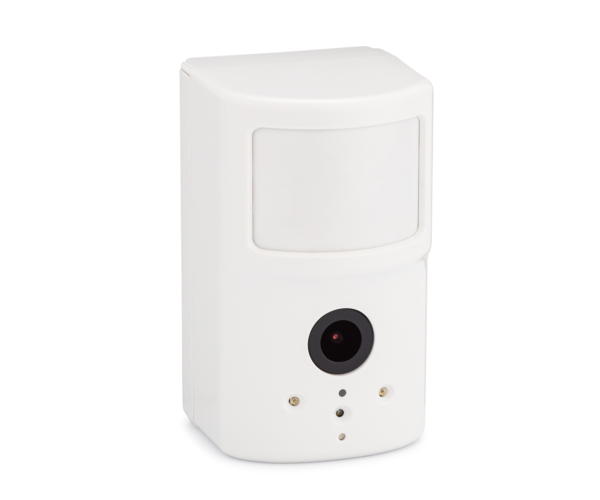
DSC offers a couple of PowerG PIR Cameras that will work with the Qolsys IQ Panel 2 and IQ Panel 4 in addition to the DSC PowerSeries Neo panels with a PowerG Transceiver added. These are the DSC PG9934P, Indoor PIR Camera, and the DSC PG9944, Outdoor PIR Camera. These sensors work like any other PowerG Sensor with the Qolsys Panels. They can only capture images when the system is armed and the image sensor is active (not bypassed). They send their images to the panel, and then the first image is uploaded to Alarm.com. A total of ten (10) images are taken, and these images are stitched together by the panel into a sort of stop-motion video where each image can also be viewed individually. This is done via the panel screen itself. When used with the PowerSeries Neo panels, the DSC PIR Cameras can be used for Visual Verification only, they do NOT work like a regular image sensor with Alarm.com.

DSC PG9934P, Indoor Image Sensor:

DSC PG9944, Outdoor Image Sensor:


The Honeywell Home PROINDMV is a wireless PIR motion sensor with a camera built-in, just like the 2GIG, Qolsys, and Alarm.com image sensors were. The PROINDMV is currently only supported on the Resideo PROA7PLUSC, and Honeywell Home PROA7PLUS panels. There is no "peek-in" option for these image sensors. They can only capture images when they sense motion while the system is armed in Away mode. Images or videos are captured and uploaded to Total Connect 2.0 for viewing. The user can choose to receive either a still image or a 10-second video clip. You can read their full details of operation in our previous post.

Honeywell Home PROINDMV:


It seems like the era of the image sensor may be coming to a close, at least for now. Who knows, once we're through the global chip shortage, and the availability of components is back to normal, perhaps the humble image sensor will experience a revival. If so, DIYers may want to consider giving these sensors a try. They really are an excellent idea. They can be used for alarm verification in this age of increasing police resistance to alarm response, and they are cheaper, both initially and on an ongoing month-to-month basis, than video cameras.


Tags: , , , , , , , , , , , , , , , , , , , , , ,

Comments


Posted By

ISC West, the security industry's largest trade show, was held this week in Las Vegas. This is the first year since the COVID-19 outbreak that the show is being held in person. We didn't attend the show this year, but based on what we've seen, JCI and Qolsys won the ISC West show in 2022.

Qolsys:

IQ Pro

Qolsys, Inc. which was acquired by Johnson Controls in 2020, premiered two brand new products, and reintroduced one more. The IQ Pro Panel is a hybrid wired and wireless system which targets large homes, and medium to large businesses. It combines the reliability of hardwired components with the range and versatility of the DSC PowerG Sensor lineup. The product is planned for release in Summer, 2022.

There is very little information available about the IQ Pro. The Press Release announcing the product, which was released by Johnson Controls, didn't even say for certain that it would be a Qolsys branded product, though with 'IQ' as a part of the name, we assume it will be. This panel will combine elements of the IQ Panel 4 with the DSC PowerSeries Neo, and a little bit of customer feedback thrown in. A couple of things we do know, the IQ Pro will offer the choice of either Ethernet or WIFI connectivity along with LTE. This panel has been designed with Alarm.com for Business in mind, to take advantage of all the extended features offered there.

IQ WIFI 6

The Qolsys IQ WIFI 6 was actually first introduced to us here at Alarm Grid last year. It is a product we thought was going to released then, but it was introduced at ISC West and should be available in Summer, along with the IQ Pro. The IQ WIFI 6 is is a router that uses 802.11 1/b/g/n/ac/ax WIFI-6 technology. It offers dual-end 2.4 GHz and 5 GHz MIMO mesh architecture on a Qualcomm Networking Pro 400 platform. It will integrate with Qolsys touchscreen panels, to allow a user to administer the network from there.

The IQ WIFI 6 will offer four (4) network partitions, including a Guest Network and a dedicated network for the end-user's WIFI devices. Both of these will switch automatically between 2.4 GHz and 5GHz for seamless optimization of WIFI performance. In addition to these partitions, there are two (2) private network partitions to be used by security and/or networking providers. By separating the security, surveillance, and smart home devices from the rest of the network, professional providers can cut down on disruptions caused by user error.

IQ Hub

The Qolsys IQ Hub has actually already been released, in a limited fashion within the last six (6) months or so. Presumably due to supply chain issues, Qolsys has tightly controlled how many of these panels are shipped, but now, based on a press release this week, it seems like they may be looking to perform a wider release. The IQ Hub differs from the IQ Panel 4 in several ways, one of which is that each panel will only support one RF product line. There is a PowerG version with either an AT&T or Verizon communicator. This is the only version that has been released at this time. Soon however, there will be a version that supports unencrypted, uni-directional Honeywell and 2GIG wireless sensors, one that supports unencrypted, uni-directional Interlogix and all Qolsys wireless sensors, and a version that supports uni-directional DSC 433 MHz wireless sensors.

Resideo:

Cellbounce

Resideo and Honeywell Home brought the Cellbounce to ISC West. This device will bridge communicators that work on the AT&T 3G network over to the AT&T LTE network, without having to replace the device. This is a plug-n-play device. It connects to an outlet within range, which is 25' (7.62m), of the existing AT&T 3G communicator, though be sure not to plug the Cellbounce in until it has been configured by your alarm dealer.

It syncs to the 3G communicator, then with the LTE network and any signals sent by the communicator will be picked up and transported via LTE. It even works with Total Connect 2.0, though it does not work with two-way voice. It also only works in the contiguous United States, so Alaska, Hawaii, and Puerto Rico residents, the Cellbounce is not for you. There are some other caveats and limitations, so be sure to read our product description carefully before purchasing.

2GIG, Nortek Control:

2GIG Edge

In October of 2021 Nortek Control, the parent company of 2GIG, was purchased by Nice. Nice originated in Italy, with Nice North America handling the US and Canadian segment of the business. This year at ISC West, Nice put their stamp on this relatively new acquisition. In addition to some commercial camera innovations by Linear, Nice/Nortek Control announced during ISC West that they will offer exclusive integration between the 2GIG Edge security panel and the ELAN Home Control platform. The Edge has been out for about a year now. You can read all about it here.

According to their press release, this integration will be supported by the ELAN SC-100 and ELAN SC-300 system controllers running ELAN 8.7 OS (which won't be available until April, 2022). The 2GIG Edge panel requires firmware version 3.1.1.0 or later. Firmware can be pushed through Alarm.com or downloaded. This panel firmware version is not available from 2GIG just yet, but once it is posted, our page will be updated. One of the more convenient features of this integration is the ELAN Control Auto Zone Detection feature. If the ELAN system is setup first, with zone names, once the 2GIG Edge is installed, it can download all zones and zone names directly from ELAN, without having to re-enter the information.


Tags: , , , , , , , , , , , , , , , , , , , ,

Comments


Posted By

ConEd

As we've reported before, Alarm.com partners with electrical power providers all over the country in a demand response program called Give Back Get Back. In exchange for allowing your participating provider to adjust your thermostat slightly during peak demand hours, you receive a bonus.

According to Alarm.com, there are typically between six (6) and ten (10) peak events per summer season. Customers who opt into this program in their area will receive advance notice of any adjustment that is planned for their location. They have the ability to opt-out of a particular event, or the entire program, at any time. The most recent additions to the Give Back Get Back program are:

AEP PSO of Oklahoma

AEP PSO calls this program PSO's Power Hours program. In order to be eligible, you must be a PSO residential customer and the electric service must be in your name. You must have an eligible internet-connected smart thermostat controlling your central air conditioning. And you must agree to allow PSO to make brief, small adjustments to your thermostat during Peak Events on high demand days.

As an incentive, you will receive a $50 e-gift card per eligible device, once you have successfully enrolled that device into the program. This e-gift card will arrive within 60 days of your acceptance in the program. It will be sent to the email address used to register for the program so be sure you enter your email address correctly when signing up! At the end of the summer season, starting in 2022, you will receive a $25 e-gift card per participating thermostat. If you are enrolled in AEP PSO Oklahoma's Time-of-Day (TOD) rate option, you can also participate in the Power Hours Program.

Qualifying Thermostats:
Manufacturer Approved Thermostats
Alarm.com Radio Thermostat CT30, CT80, CT100; Trane ComfortLink Control; RCS Z-Wave Communicating Thermostat; GoControl Z-Wave Thermostat; Alarm.com Smart Thermostat; 2GIG Z-Wave Plus™ Battery Powered Thermostat; Trane Z-Wave Thermostat; Linear Thermostat
ecobee ecobee3; ecobee3 Lite; ecobee4; ecobee Smart; ecobee SmartThermostat with Voice Control
Emerson Sensi™ WIFI Programmable Thermostat; Sensi™ Touch WIFI Thermostat
Honeywell Home WIFI Smart Color Thermostat; WIFI 7-Day Programmable Thermostat; WIFI 9000 7-Day Programmable Thermostat; 9000 Smart Thermostat; 7-Day Programmable Smart Thermostat; VisionPro 8000 Smart Thermostat; Round Smart Thermostat; T5+ Smart Thermostat; T6 Pro Smart Thermostat; T9 Smart Thermostat, T10 Smart Thermostat
Lux LUX/GEO; LUX KONO
Google Nest Google Next Thermostat; Google Nest Learning Thermostat; Google Nest Thermostat E
Radio Thermostat Company of America Filtrete 3M-50; CT30; CT50; CT80

ConEd

By enrolling in ConEd's program in 2022, customers earn a chance to win a $5,000 prize. ConEd calls their program Power Savers. To be eligible to participate, you must be a resident of New York with an electric utility account, you must use your thermostat to control central air conditioning, and you must have installed an eligible thermostat. Note that the list of eligible thermostats is quite a bit smaller for ConEd.

Qualifying Thermostats:
Manufacturer Approved Thermostats
Alarm.com Radio Thermostat CT30, CT80, CT100; Trane ComfortLink Control; RCS Z-Wave Communicating Thermostat; GoControl Z-Wave Thermostat; Alarm.com Smart Thermostat; 2GIG Z-Wave Plus™ Battery Powered Thermostat; Trane Z-Wave Thermostat; Linear Thermostat
ecobee ecobee3; ecobee3 Lite; ecobee4; ecobee Smart; ecobee SmartThermostat with Voice Control
Lux LUX/GEO; LUX KONO
Radio Thermostat Company of America Filtrete 3M-50; CT30; CT50; CT80

AEP ApCo Virginia

With AEP ApCo, Appalachian Power Virginia, enrolled customers receive a $50 e-gift card upon enrollment and acceptance into the program. In addition, customers can earn up to $25 in e-gift cards at the end of the season ($5 for each summer month of participation from May - September).

To be eligible to enroll, you must be an Appalachian Power, VA residential electric customer, and the electrical service must be in your name. Once you install an eligible inter-connected smart thermostat for your central air conditioning system and sign up to allow Appalachian Power to make brief, small adjustments to your thermostat on days of high energy demand, you will receive your e-gift card. It should arrive within 60 days of being accepted into the program. The e-gift card will be sent to the email address used to register your thermostat, so be sure you enter your email address correctly, then be on the lookout for your gift card!

Qualifying Thermostats:
Manufacturer Approved Thermostats
Alarm.com Radio Thermostat CT30, CT80, CT100; Trane ComfortLink Control; RCS Z-Wave Communicating Thermostat; GoControl Z-Wave Thermostat; Alarm.com Smart Thermostat; 2GIG Z-Wave Plus™ Battery Powered Thermostat; Trane Z-Wave Thermostat; Linear Thermostat
ecobee ecobee3; ecobee3 Lite; ecobee4; ecobee Smart; ecobee SmartThermostat with Voice Control
Emerson Sensi™ WIFI Programmable Thermostat; Sensi™ Touch WIFI Thermostat
Honeywell Home WIFI Smart Color Thermostat; WIFI 7-Day Programmable Thermostat; WIFI 9000 7-Day Programmable Thermostat; 9000 Smart Thermostat; 7-Day Programmable Smart Thermostat; VisionPro 8000 Smart Thermostat; Round Smart Thermostat; T5+ Smart Thermostat; T6 Pro Smart Thermostat; T9 Smart Thermostat, T10 Smart Thermostat
Lux LUX/GEO; LUX KONO
Google Nest Google Next Thermostat; Google Nest Learning Thermostat; Google Nest Thermostat E
Radio Thermostat Company of America Filtrete 3M-50; CT30; CT50; CT80
Vivint Radio Thermostat CT100 with Vivint Go!Control Panel

If you're an Alarm Grid customer and you use an Alarm.com compatible panel with a Z-Wave or WIFI Smart Thermostat, you may be eligible to enroll in the same type of program in your area. To find out, you can go to enrollmythermostat.com, enter your Zip Code in the space supplied, and find out if your electrical, and in some cases gas company participates in the Give Back Get Back Program. As the old saying goes, every little bit helps!

Have a security-related topic you'd like to hear more about? Drop a comment in the space below and we'll research and post relevant information. What do you think about the Give Back Get Back Program? Are you in an area where you can take advantage of this feature? If not, contact your utilities provider, maybe they're unaware of this incentive program.

Tags: , , , , , , , , , , , , , , , , , , ,

Comments